The Jacketed Glass Reactor (Double layer Glass Reactor) is a commonly used chemical equipment. It consists of multiple key components. The main components include the kettle body, kettle cover, jacket, agitator, transmission device, shaft seal device and bracket. Each component has its specific function:
1. Kettle body: It is the space for the material to react. It usually consists of a cylinder and upper and lower heads. Sometimes manholes, hand holes and process pipelines are provided as needed.
2. Kettle cover: Connected to the kettle body. Can be directly welded or flanged. The design of the upper cover depends on whether it needs to be easily disassembled.
3. Jacket: Located outside the kettle wall, it is used for the circulation of heating or cooling media and controlling the temperature of the reaction materials.
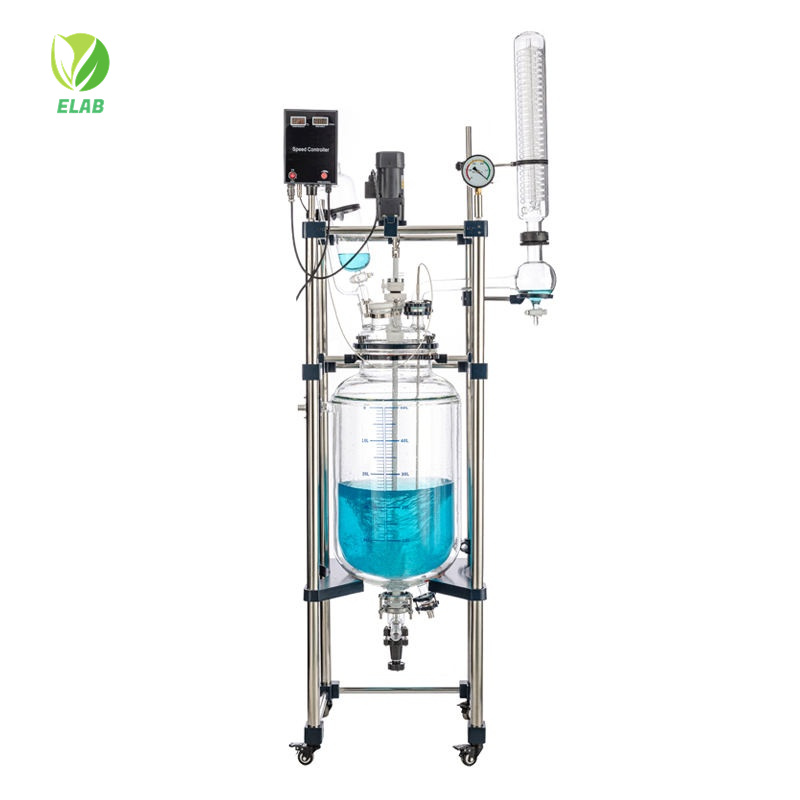
4. Agitator: Usually in the form of anchor type, paddle type, turbine type, etc., used to speed up the reaction speed, enhance mixing and mass transfer or heat exchange effect.
5. Transmission device: Including motor and reducer to ensure that the agitator can rotate stably at a certain speed.
6. Shaft seal device: dynamic sealing structure, mainly including packing seal and mechanical seal, used to ensure the sealing of the rotating shaft.
7. Support: including support type or ear type support, etc., used to support the weight and stability of the entire reactor.
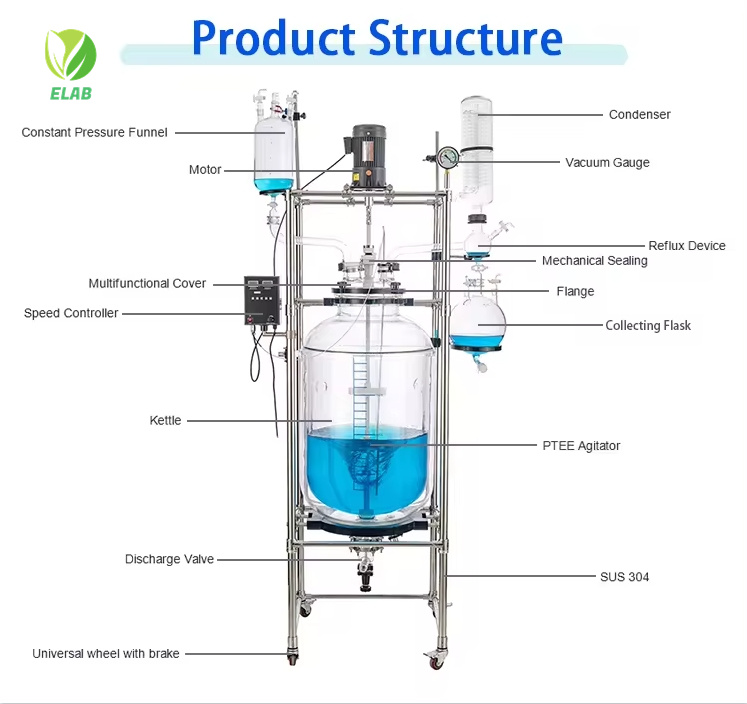
The specific functions of each component in the Jacketed Glass Reactor (Double layer Glass Reactor) are as follows:
1. Kettle body and kettle cover: provide a closed environment for the reaction to ensure that the reactants react under the set conditions.
2. Jacket: control the temperature of the reactants through the heat medium (such as hot water, hot oil or freezing liquid) in the jacket to achieve constant temperature heating or cooling.
3. Agitator: quickly and evenly mix the reactants, enhance the mass transfer and heat transfer process, and thus speed up the reaction.
4. Transmission device: drive the agitator to rotate to ensure continuous and uniform reaction of the reactants.
5. Shaft seal device: prevent liquid or gas leakage during the reaction process and maintain the sealing of the reaction environment.
6. Support: ensure the stability of the reactor and facilitate installation and maintenance.
The design of the Jacketed Glass Reactor (Double layer Glass Reactor) enables it to carry out various chemical reactions such as concentration, distillation, reflux, separation, purification, etc. under constant speed, constant force and constant temperature conditions. It is widely used in chemical industry, biopharmaceuticals, scientific research experiments and other fields.
Wonderful! Share this Blog: