When you walk into a modern R&D lab, the first thing that catches the eye is often the sparkling glass vessel sitting on a sturdy frame, circled by hoses and circulators. These are jacketed glass reactors, and they come in many shapes and capacities. Understanding the Different Types of Jacketed Glass Reactor is the fastest way to avoid buying the wrong unit and blowing the budget. This quick guide focuses on the 1 L to 50 L range, the sweet spot for most academic, scale-up, and pilot-plant work.
1. Single-Jacket Reactor (1 L – 5 L)
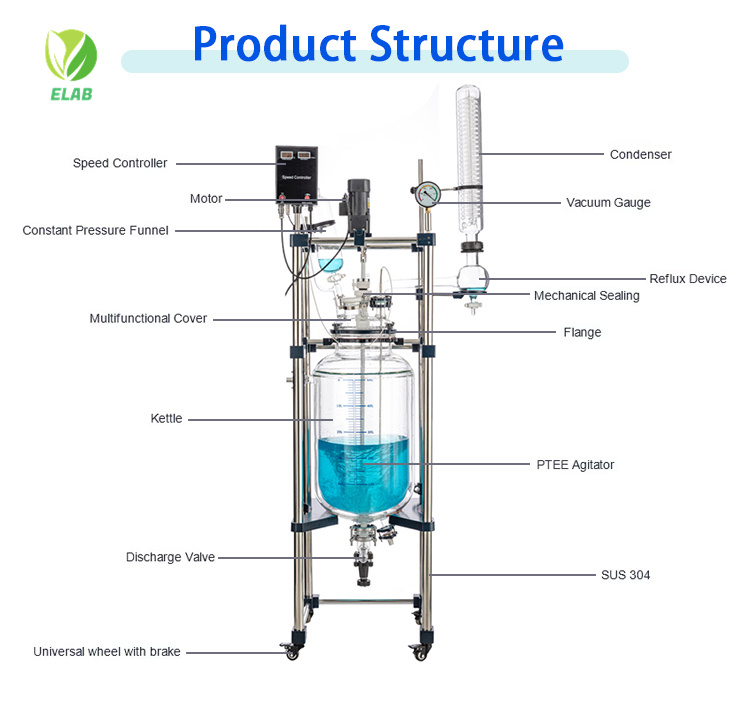
The simplest of the Different Types of Jacketed Glass Reactor is the single-jacket version. One outer glass wall forms a sealed cavity through which thermal fluid is pumped. Because the jacket is welded to the vessel, the heat-transfer area is fixed, making the design inexpensive and light. Researchers love the 1 L and 2 L sizes for screening reactions: they fit inside a fume hood, need only 1 L of bath fluid, and cost under $1 200. The downside is limited temperature range (–30 °C to +150 °C) and no vacuum insulation, so ice forms on the outside during cryogenic runs.
2. Double-Jacket Reactor (10 L – 20 L)
Stepping up in both volume and sophistication, the double-jacket (or “vacuum jacket”) model is the workhorse of the Different Types of Jacketed Glass Reactor family. An extra outer shell creates a vacuum barrier that drastically reduces heat loss and condensation. The 10 L and 20 L sizes dominate kilo-lab campaigns where yield consistency is critical. Users routinely swing from –80 °C to +200 °C using a single TCU (thermocirculator) without frosting. Expect to pay 30 % more than a single-jacket unit, but energy savings usually recover the delta within a year.
3. Triple-Jacket Reactor (30 L – 50 L)
At pilot scale, safety and stability rule. The triple-jacket design adds a third, protective glass layer that guards against thermal shock and mechanical impact. Among the Different Types of Jacketed Glass Reactor, this is the only version that meets the stricter DIN 12216 “secondary containment” guideline. The 30 L and 50 L models are often delivered with Hastelloy bottom valves, 450 W overhead stirrers, and built-in baffles for improved mixing. If you plan hydrogenations or fluorination chemistry, the triple jacket is worth the premium.
4. Filter Reactor Hybrid (10 L – 30 L)
Not every synthesis ends in a liquid; sometimes the product is a solid. A clever hybrid that is gaining traction within the Different Types of Jacketed Glass Reactor lineup is the filter reactor. It looks like a normal jacketed vessel, but the base integrates a 10 µm to 100 µm glass frit. After crystallization, the user simply lowers the stirrer, applies slight nitrogen pressure, and collects the mother liquor below. One 20 L unit can replace a separate Büchner set-up, saving hood space and cross-contamination risk.
5. Modular “Kit” Reactor (1 L – 5 L interchangeable)
Start-ups and teaching labs prize flexibility. The newest entry among the Different Types of Jacketed Glass Reactor is the modular kit: one universal stand, one circulator, and three interchangeable vessels (1 L, 2 L, 5 L). Quick-release clamps let a single researcher swap sizes in under five minutes. The glass is reinforced with 3.3 borosilicate, and all wetted parts are USP Class VI compliant, so the same hardware toggles between medicinal-chemistry route scouting and small-scale GMP demonstration.
Key selection tips
• Match the circulator’s dynamic pressure curve to the jacket volume; a 50 L triple-jacket needs at least 25 L min⁻¹ flow to avoid hot spots.
• Verify the drain valve orientation; 30 L and 50 L reactors weigh 80 kg when full, so a bottom-flush valve saves back strain.
• Ask for a calculated heat-transfer coefficient (U-value) chart; suppliers of reputable Different Types of Jacketed Glass Reactor provide this free.
• Budget 15 % of the purchase price for consumables—O-rings, PTFE stirrer guides, and safety shields—every 18 months.
Take-home message
Whether you need a 1 L single-jacket for early discovery or a 50 L triple-jacket for toxicological campaigns, the Different Types of Jacketed Glass Reactor outlined above cover 90 % of real-world demand. Map your temperature range, solvent compatibility, and future scale before you click “buy.” Do that, and the right reactor will still be running strong when your project moves from gram dream to kilogram reality.
Wonderful! Share this Blog: