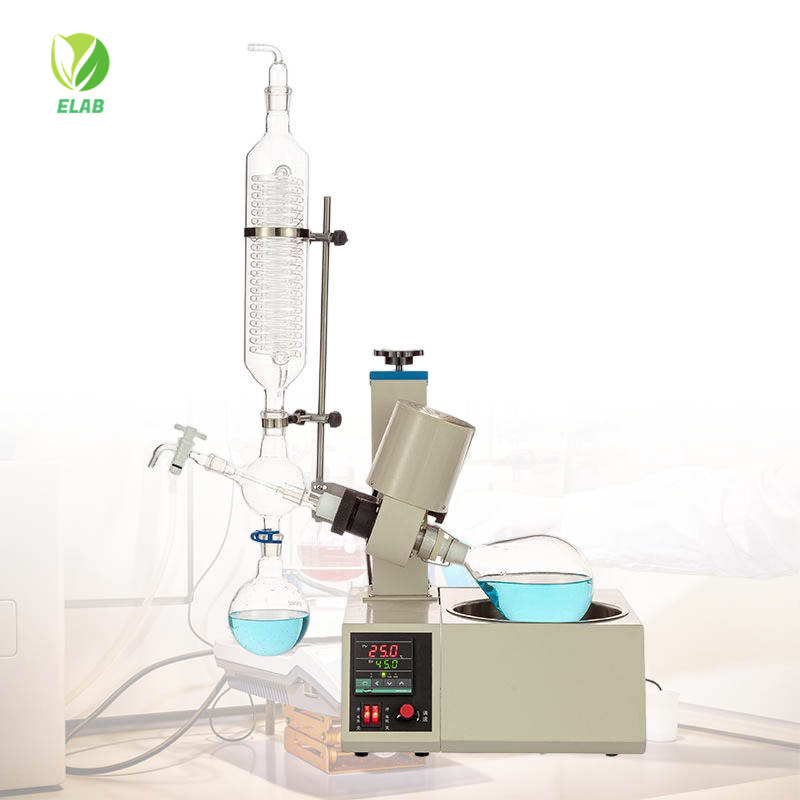
Rotary evaporator, also known as rotary evaporator or rotary evaporator for short, is a common laboratory equipment. It is composed of motor, distillation flask, heating pot, condenser and other parts. It is mainly used for continuous distillation of volatile solvents under reduced pressure conditions and is used in chemistry, chemical industry, biomedicine and other fields.
Working principle of small rotary evaporator:
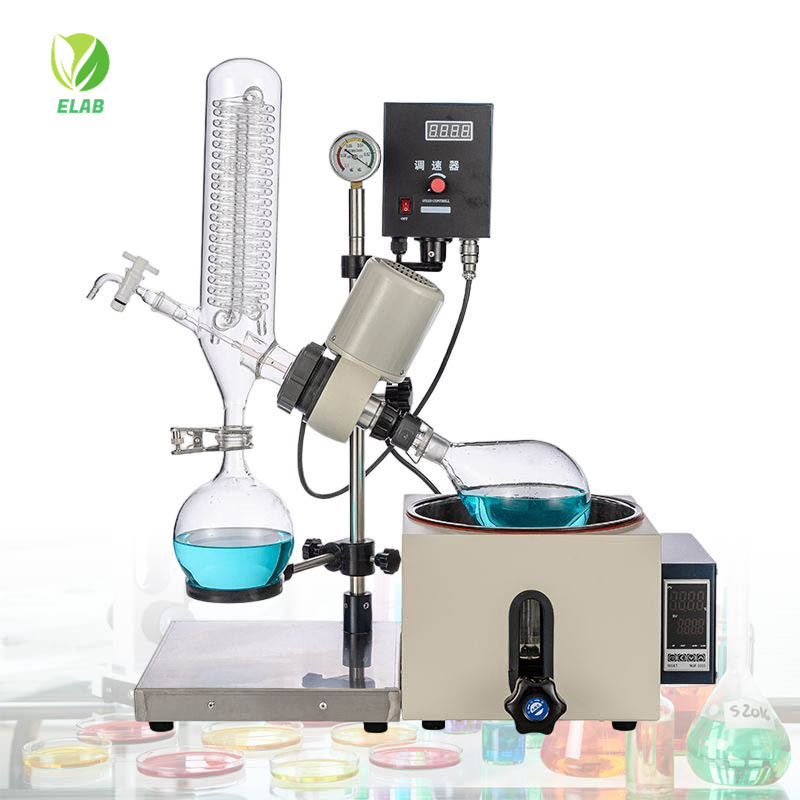
Through electronic control, the flask is rotated at a constant speed at the most suitable speed to increase the evaporation area. The evaporation flask is placed under negative pressure through a vacuum pump. The uniform rotation increases the evaporation area, and at the same time, it is placed in a water bath for constant temperature heating, so that the solution in the bottle is heated and diffused in the rotating flask under negative pressure. The rotary evaporator system can be sealed and decompressed to 400~600 mmHg; the solvent in the distillation flask is heated with a heating bath, and the heating temperature can be close to the boiling point of the solvent: it rotates at the same time, the speed is 50~160 revolutions per minute, and the solvent forms a thin film to increase the evaporation area. In addition, under the action of the high-efficiency cooler (usually a condenser), the hot steam can be quickly liquefied to accelerate the evaporation rate. Precautions for the use of a small rotary evaporator: 1. When using, first draw a small vacuum (about 0.03MPa), then start rotating to prevent the distillation flask from slipping. When stopping, stop rotating first, hold the distillation flask by hand, and let the atmosphere in. Wait until the vacuum drops to about 0.04MPa before stopping the vacuum pump to prevent the distillation flask from falling off and back-sucking. 2. Each ground mouth, sealing surface sealing ring and joint need to be coated with a layer of vacuum grease before installation. 3. Water must be added to the heating tank before powering on. Dry burning without water is not allowed. 4. If the vacuum is too low, pay attention to check the air tightness of each joint, vacuum tube, and glass bottle. Rotate the air-sensitive material, connect an ammonia balloon to the exhaust port, first pass a burst of ammonia, come out of the air rotator, and then connect to the sample bottle to rotate. After passing ammonia, increase the pressure, then stop the pump, remove the sample bottle and seal it for storage.
Wonderful! Share this Blog: