In the world of fish oil refining and purification, glass reactors are mostly used in lab R&D, small-scale trials, and pilot production runs. Their real value comes from the fact that you can see right through the glass — making the whole purification process "visible." That's a big help when you're trying to develop a process or keep quality in check.
Right now, three main types of glass reactors are used in this area:
I. Core Equipment Types
Equipment Type Main Role in Fish Oil Purification Key Advantages
Glass Crystallization/Solid Phase Reactor Used for the crystallization, purification, and filtration of fish oil. It can separate saturated fatty acids from other components in fish oil. Integrates reaction and filtration, with built-in filter plates, allowing for vacuum filtration, simplifying the operation process. Glass Molecular Distillation/Short-Path Distillation Equipment Used for the refining and purification of heat-sensitive active ingredients such as DHA and EPA. Particularly suitable for separating substances with similar boiling points or poor thermal stability.
1. Protecting Heat-Sensitive Components: Operating at high vacuum and low temperature avoids oxidation and degradation of DHA/EPA.
2. Highly Efficient Impurity Removal: Gets rid of harmful small molecules and bad smells from the raw material.
Glass Double-Layer/Jacketed Reactor: This is a general-purpose mixing and reaction container. It's used for pretreatment, mixing, saponification, esterification, and other steps before or after the main process. The jacketed design gives you precise temperature control (heating or cooling), which is really important when working with temperature-sensitive fish oil.
✅ II. Why glass reactor is a Good Fit ?
The glass reactor is so popular in fish oil refining mainly for these reasons:
See-Through Process, Easy to Keep an Eye On: The high borosilicate glass body is extremely clear, so researchers can watch the fish oil change during stirring, crystallization, and distillation — things like color, layers, and bubbling. This makes it easy to tweak the process settings on the fly.
Sturdy Material, Won't Rust or React: High borosilicate glass stands up very well to chemical damage. It resists being eaten away by fish oil, solvents, acids, alkalis, and other chemicals used in processing, which helps keep the final product pure.
Protection of Active Ingredients: Glass reactors equipped with molecular distillation technology can operate at temperatures far below atmospheric pressure boiling points, greatly protecting the precious DHA and EPA in fish oil from heat damage.
Safety and Customization: Many devices offer explosion-proof designs, ensuring operational safety. Manufacturers also generally support customization based on specific user process requirements.
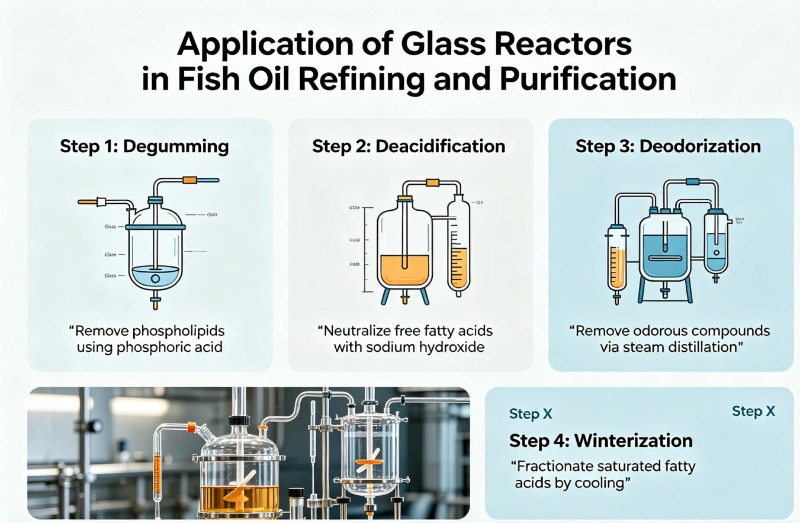
III. Application Scenarios and Limitations for glass reactor
Main Application Scenarios:
Laboratory R&D: Universities and research institutes explore new processes and routes for fish oil purification.
Small-Scale and Pilot Production: Before scaling up production, companies use glass equipment for small-batch trial production to verify the feasibility and stability of the process.
Application Limitations:
Limited Scale: Due to the strength of glass and manufacturing processes, the individual volume of glass reactors is typically small (commonly from 500mL to 200L), making it difficult to handle large-scale industrial production.
Lower Mechanical Strength: Compared to stainless steel equipment, glass is more fragile and requires more sophisticated operation and maintenance.
Summary
In short, glass reactors are a powerful tool in the R&D and pilot production stages of fish oil refining. By providing a transparent reaction process, mild processing conditions, and a corrosion-resistant environment, they help researchers and companies precisely control the purification process, especially offering irreplaceable advantages in protecting heat-sensitive components such as DHA/EPA. For stages requiring large-scale production, companies typically scale up the process data obtained from glass equipment to industrial equipment made of stainless steel.
Wonderful! Share this Blog: