In chemical synthesis experiments, small rotary evaporators are used to remove solvents and concentrate solutions.
1. Preparation : Place the small rotary evaporator on a stable surface to check whether all components such as the vacuum pump and temperature control system work normally. Pour the solution that needs to be evaporated into the round-bottomed flask, taking care not to exceed its maximum capacity so as not to overflow.
2. Setting : Fix the flask on the rotating platform of the small rotary evaporator and ensure that it is fixed firmly. Set the speed and heating temperature according to the experimental requirements. The general speed is adjustable between 50 and 300 RPM, and the heating temperature is usually between 30 and 60 degrees Celsius.
3. Operation : Start the vacuum pump to form a suitable vacuum degree in the system. Start the heating system and start heating the solution in the flask. Monitor the evaporation of the solution in the flask and keep it in a liquid state to avoid drying.
4. Monitoring : Observe the evaporation process, adjust the heating temperature, rotation speed and vacuum degree to achieve the best results. It is crucial to keep the solution flowing to form a film on the flask wall, which increases the surface area and accelerates solvent evaporation.
5. Complete : After the solution reaches the required concentration, turn off the heating system and vacuum pump of the small rotary evaporator. Remove the concentrated solution for storage or further processing.
6. Cleaning and maintenance : After each use, clean the surface of the flask and evaporator to ensure that the equipment remains dry and clean, extending its service life.
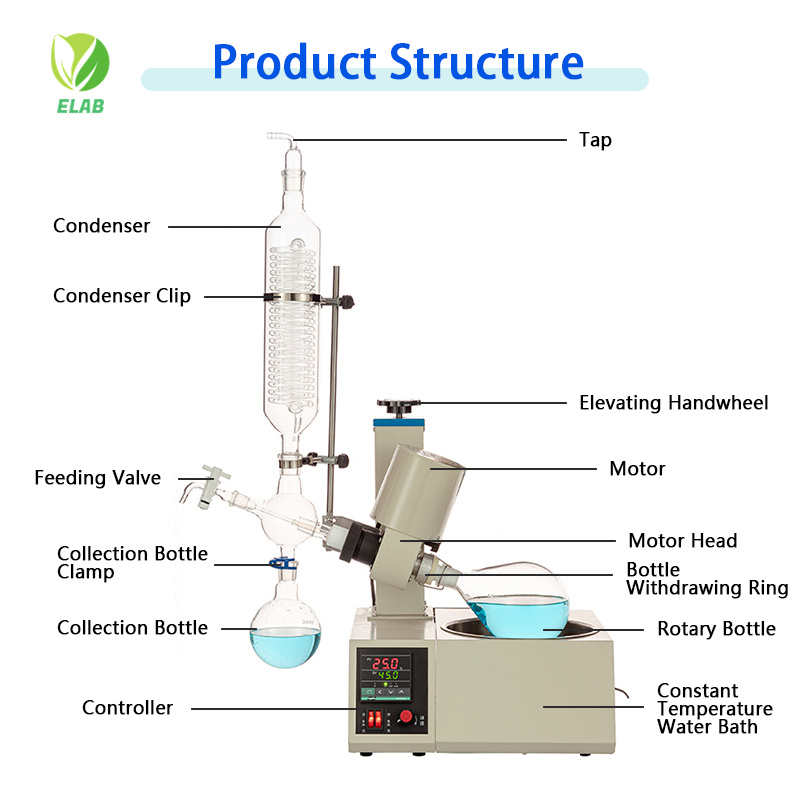
Small rotary evaporators are essential tools for handling solvents in the laboratory, improving the efficiency and accuracy of solvent evaporation through rotation and vacuum technology. Following these guidelines ensures smooth operation and maximizes solvent concentrations in chemical synthesis experiments.
Wonderful! Share this Blog: