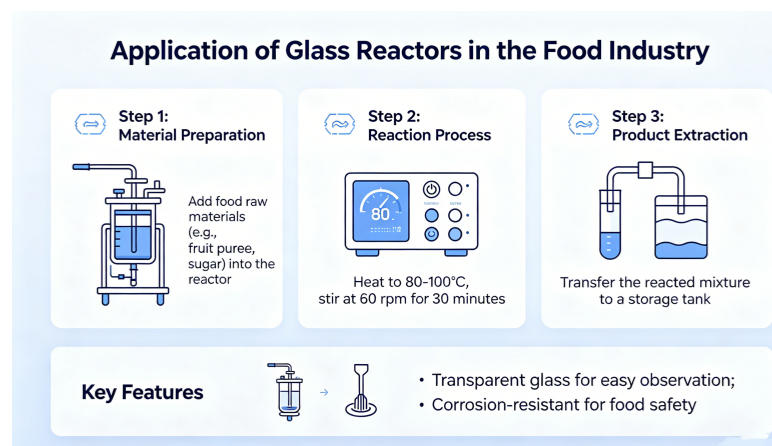
Glass reactors are becoming more and more common in the food industry, especially for product development, small-batch production, and quality checks. Their main strengths are: you can see what's happening inside (watch the reaction), control temperature precisely (to protect heat-sensitive ingredients), and they're made of safe material that resists corrosion and won't leach metals.
These features make them a great fit for working with high-value, heat-sensitive, easy-to-oxidize, or highly acidic food ingredients. Here are a few key ways they're used in the food industry:
1. Refining and Purifying Functional Oils
This is a very typical application scenario for glass reactors, particularly suitable for processing raw materials rich in polyunsaturated fatty acids, such as fish oil and algal oil.
What it's used for: pulling out EPA/DHA from fish oil, extracting vitamin E, and isolating monoglycerides (GMS), to name a few.
Why it's valuable: Under strong vacuum, you can run molecular distillation or purification at fairly low temperatures (say, 50-60°C), which helps stop heat-sensitive nutrients from breaking down due to oxidation. At the same time, the reactor jacket gives you tight temperature control, so you can get the same results every time.
2. Research and Development of Flavors, Fragrances, and Food Additives
Glass reactors are ideal tools for laboratory and pilot-scale development of new flavor compounds or functional additives.
Typical Applications: Extraction and mixing of flavors, formulation of flavor compounds, synthesis and purification of food additives -1-4-10.
Core Values: The glass material meets food-grade cleanliness requirements and is resistant to acid and alkali corrosion -4-10. The reaction process is completely transparent and visible, allowing researchers to directly observe mixing, emulsification, crystallization, and other phenomena, facilitating timely adjustments to process parameters -8.
3. Food Testing and Sample Pretreatment
This is a key way glass reactors are used in food quality control (QC)—to get accurate readings on what’s actually in a food product.
Typical Applications: High-efficiency extraction (e.g., detecting the antioxidant TBHQ in edible oils, pesticide residues in vegetables), precision distillation (e.g., detecting methanol content in liquor, volatile acids in vinegar) -8-10.
Core Values:
Saves Time: Compared to traditional shaking extraction, you can cut the extraction time from 2 hours down to just 30–60 minutes.
Avoids Cross-Contamination: The unit comes apart easily for cleaning, so there are no hard-to-reach spots where residue can hide. Every part that touches your ingredients is made of high borosilicate glass and PTFE, which means no metal ions get into your samples—keeping different test runs separate and clean.
Why Does the Food Industry Prefer Glass Reactors? (Key Benefits) Compared to stainless steel gear, glass reactors bring some unique benefits to food applications:
Safe, Non-Reactive Material: The main body is high borosilicate glass (like G3.3), which is very chemically stable. It can handle common food acids (like glycolic acid), oils, and solvents used in food processing. Unlike metal tanks, it won't release iron or copper ions, so your product stays purer and keeps its original taste.
Spot-On Temperature Control: The double glass jacket lets you circulate hot or cold fluid, giving you precise control from -80°C to 200°C, with accuracy within ±0.5°C to ±1°C. This is key for preserving the natural flavors and active components in many food ingredients.
Complete Process Transparency: Researchers can directly observe the changes in the material's state during stirring, mixing, dissolving, and crystallizing within the reactor. This is an advantage that stainless steel reactors cannot provide, making it invaluable for process development and optimization.
Easy to Clean and Keeps Things Contamination-Free: The smooth, non-porous glass surface stops material from sticking or building up. Because the parts can be taken apart, cleaning and checking them is straightforward and effective. That’s why it’s a great fit for the food industry, where hygiene standards are extremely strict.
Wonderful! Share this Blog: