The purification of EPA and DHA from fish oil involves multiple sensitive steps, including saponification, esterification, and molecular distillation. Among available equipment, the glass reactor stands out as the preferred choice for both R&D and pilot-scale production. Its unique material properties and design directly address the chemical and physical challenges of omega-3 refining.
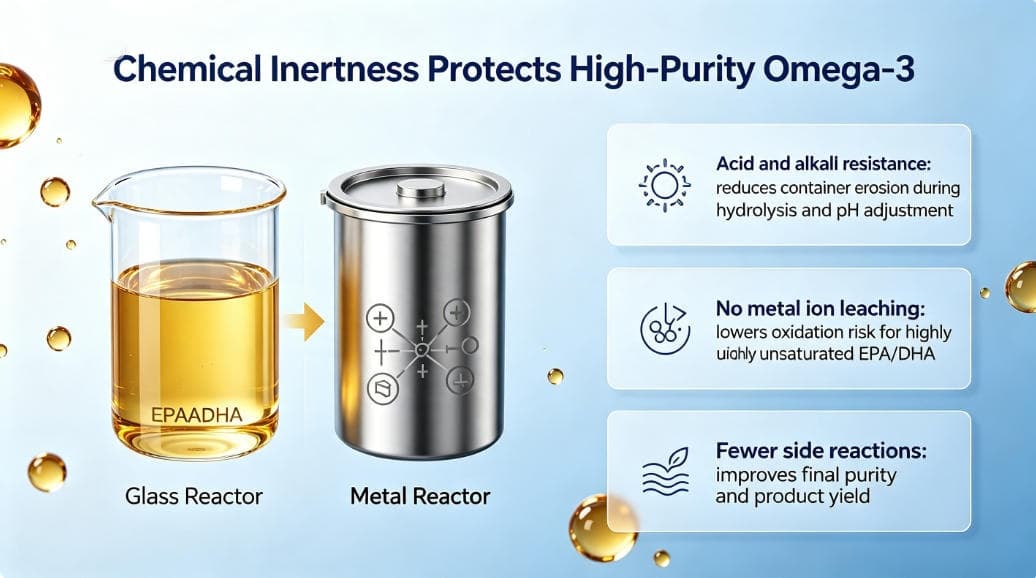
First, the glass reactor offers exceptional chemical inertness. Fish oil processing often uses strong alkalis (e.g., NaOH) and acids (e.g., HCl) for hydrolysis and pH adjustment. Unlike stainless steel, a glass reactor resists corrosion, preventing metal ion leaching that could catalyze oxidation of highly unsaturated EPA/DHA. This inertness ensures higher final purity and fewer side reactions.
Second, the transparency of the glass reactor is invaluable for process control. During urea complexation or winterization, operators can visually monitor phase separation, crystal formation, and mixing efficiency in real time. This visibility, unique to the glass reactor, allows immediate adjustments to temperature or stirring speed, reducing trial-and-error losses. Furthermore, the glass reactor’s smooth inner surface minimizes fouling by viscous intermediates, simplifying cleaning between batches.
Third, temperature management is critical because EPA/DHA are thermally labile. A jacketed glass reactor enables precise heating/cooling using circulating fluids, with rapid response to exothermic or endothermic events. The low thermal expansion coefficient of borosilicate glass also prevents cracking under rapid thermal shifts—a safety advantage over metal vessels, which may require costly insulation. Additionally, the glass reactor supports vacuum operation, essential for deoxygenation to inhibit peroxidation.
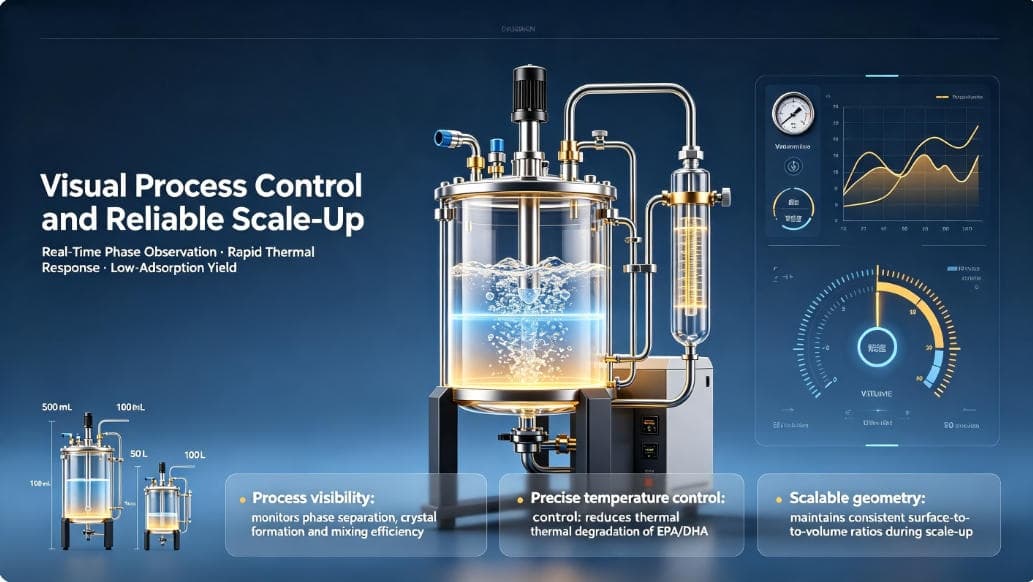
Finally, scalability and validation favor the glass reactor. From 500 mL to 100 L, the glass reactor series maintains identical surface-to-volume ratios, easing scale-up. Its non-adsorptive walls prevent EPA/DHA loss via surface binding, improving yield. For GMP-compliant production, the glass reactor’s transparency simplifies visual inspection of cleaning validation, while its all-inert wetted parts eliminate contamination risks from gaskets or welds. In summary, the glass reactor synergizes corrosion resistance, observability, thermal control, and scalability—making it irreplaceable in high-value omega-3 purification.
Wonderful! Share this Blog: